The era known to us as the Renaissance began approximately around the beginning of the fifteenth century, in Florence. The philosophy behind the whole movement is one of "rebirth" or the re-establishing of ancient classical culture.
Following the collapse of the Roman civilization much of Europe fell into decline, losing a great deal of information concerning that period. Therefore knowledge concerning the architecture of that age could only be acquired via the classical ruins that litter the Italian landscape; and through the writings of the Roman architect Vitruvius. In this period of time they weren't only learning from Romans, they also had their own invention. We can say that they learn from Romans ,followed Gothic and came up with their own method.
Thus one of the greatest (and most fundamental) achievements of the renaissance is the rediscovery of the basic elements of classical architectural design, especially those concerning construction. The results of this achievement can be seen in the construction of buildings such as Florence Duomo.< Begun in 1294, the Florentine people almost exceeded the limit of their abilities in their enthusiasm to build an impressively large Cathedral, and consequently could find no method to cover it. Which was completed by the guy who was being condemn as crazy person, Brunelleschi.
Although less well-known today than Leonardo's Canon of proportion and Michelangelo's David, Brunelleschi creation is a uniquely tangible expression of the Renaissance's celebration of the divine power of the individual. But Brunelleschi's genius didn't end with revolutionary design for the Florence Duomo. The engineering and construction of the dome, which was impossible in architecture history in the fifteenth-century. If we compare to technological at that time, it was equivalent of putting a man on the moon. And thanks to his insight into the lost classical wisdom of perspective and proportion not only facilitated a visual expression of the times' empowerment of the individual, but exerted an influence on all of the arts of the Renaissance that cannot be overstated.
The second person that people would recognized more than his hero is Michelangelo who was so famous for his widely skills on

Prayer from the heart can achieve what nothing else can in the world. Properly understood and applied, it is the most potent instrument of action. - MAHATMA GANDHI
Sunday, April 17, 2011

Sunday, April 3, 2011
even if it's revolution, they still have their principle same as history.
As i posted earlier article about "FILIPPO BRUNELLESCHI" and how became a legend in Renaissance time by learning from history and adapting to his time. As far as we learned from history class and do some reading, I actually found out that most of renowned architects in each period or movement actually borrowed and adapted some principle from earlier period of time but they actually made it better or make it suited with their time.
So let's start with Classical to Modernism. As we all know that Modernism was all about "starting from zero" and the word "bourgeois" was so unpleasant and nobody was designing something that stripped away from classical architecture. However, Le cour busier was using the principle of "golden ratio" where he claimed that every man could live in same environment as well as same kind of units according to his theory. Le Corbusier developed the Modular in the long tradition of Vitruvius, Leonardo da Vinci's Vitruvian Man, the work of Leone Battista Alberti, and other attempts to discover mathematical proportions in the human body.As we can see, Le cour busier adapted this theory from history where they only concerned over the harmonies of space and the proportion of each unit and he took it further to suited with the time that people concerned about "Humanism".
However, in late Modernism we had Louis I Kahn who was abide with modernism's restriction until he found out that it wasn't him so he went to europe and explored about ancient architecture. He learned from history and adapted it again with his own understanding and his root which is "Modernism". As we can see that, most of Kahn work concerned about people who uses space, materials that was considered bourgeois, and how well he adapted what he learned from history to his building. He did not over used what he learned, i would say, he used its softness of materials as well as the way the pay attention to shade and shadow. So we can see that his building is not so cold and plain as modernism nor over decorated like classical architecture building. He's in between these two movement, however, it took times for people to admitted his style same as Brunelleschi at his time. So he only had a short time to created his architecture before he passed away.
In my opinion, because of the restriction of Modernism, people fed up with "Less is more" and there is a movement of "Post modernism" where in early of the movement they would just said that they are not modernism by building anything that was contradicted to the theory of modernism by using classical decorative elements. And Robert Venturi is kind of leader in this movement where he had his theory about "Both and" where he concerned over aesthetic as well as how people should be living in the building. There is also late Post modernism which people called them the White or The new york five. They learned from Modernism as well as attacked them.
The thing that I learned about this movement is that they view architecture as a sign and they based their belief by saying that architecture is contingent, it changes over time upon political views, technologies, as well as the way people lives. As i mentioned earlier, even in this movement there are two views "The gray and the white". Where one concerned about classical but mainly used it to destroyed Modernism, and another one, in particular, Eisenman tried so hard to stripped away from principles but still ending up learning and using principles from the theories that he condemned.
The last one would be Post-modernism to Expressionism. Expressionism is so interesting is that for me it is a combination of modernism and post modernism. The architect that suited in this matter would be Frank Grahry whom was educated by modernist master who whole heartedly concerned over details and restriction of their own theory. However, Grahry was opposed to some subject that was too strict so he uses the expressive language of form in his architecture. We can referred this matter back to Post modernism about Venturi theory about expressive structure. Where he talked about duck building that when people passed they can recognized what kind of the building was there and it was still doing the job of "Form follow Function" . The best example of Frank Grahry building that concerned about expression of the building as well as we can still sense that his root was Modernism is "Disney music hall" where we can definately see that the form is so expressive, however, each volume of the structure is like the cube that was exploded from the tall building that surrounded his masterpeice.
As a result, we can see that each revolution that took place in architecture, no matter how hard they tried to denied that they got nothing from the past<history>, it was a lied. We can't stripped away from what we were, but we can learned from them and adapt to our society, technologies, and our needs.
So let's start with Classical to Modernism. As we all know that Modernism was all about "starting from zero" and the word "bourgeois" was so unpleasant and nobody was designing something that stripped away from classical architecture. However, Le cour busier was using the principle of "golden ratio" where he claimed that every man could live in same environment as well as same kind of units according to his theory. Le Corbusier developed the Modular in the long tradition of Vitruvius, Leonardo da Vinci's Vitruvian Man, the work of Leone Battista Alberti, and other attempts to discover mathematical proportions in the human body.As we can see, Le cour busier adapted this theory from history where they only concerned over the harmonies of space and the proportion of each unit and he took it further to suited with the time that people concerned about "Humanism".
 |
| The Modular, Vitruvius |
 |
| Golden mean proportion, Palladio |
 |
| golden ratio, Le Courbusier |
However, in late Modernism we had Louis I Kahn who was abide with modernism's restriction until he found out that it wasn't him so he went to europe and explored about ancient architecture. He learned from history and adapted it again with his own understanding and his root which is "Modernism". As we can see that, most of Kahn work concerned about people who uses space, materials that was considered bourgeois, and how well he adapted what he learned from history to his building. He did not over used what he learned, i would say, he used its softness of materials as well as the way the pay attention to shade and shadow. So we can see that his building is not so cold and plain as modernism nor over decorated like classical architecture building. He's in between these two movement, however, it took times for people to admitted his style same as Brunelleschi at his time. So he only had a short time to created his architecture before he passed away.
 |
| the sketch from europe before he built "Yale art gallery" |
 |
| Yale art gallery |
In my opinion, because of the restriction of Modernism, people fed up with "Less is more" and there is a movement of "Post modernism" where in early of the movement they would just said that they are not modernism by building anything that was contradicted to the theory of modernism by using classical decorative elements. And Robert Venturi is kind of leader in this movement where he had his theory about "Both and" where he concerned over aesthetic as well as how people should be living in the building. There is also late Post modernism which people called them the White or The new york five. They learned from Modernism as well as attacked them.
The thing that I learned about this movement is that they view architecture as a sign and they based their belief by saying that architecture is contingent, it changes over time upon political views, technologies, as well as the way people lives. As i mentioned earlier, even in this movement there are two views "The gray and the white". Where one concerned about classical but mainly used it to destroyed Modernism, and another one, in particular, Eisenman tried so hard to stripped away from principles but still ending up learning and using principles from the theories that he condemned.
 |
| vanna venturi house |
 |
| House vi, Peter Eisenman. |
The last one would be Post-modernism to Expressionism. Expressionism is so interesting is that for me it is a combination of modernism and post modernism. The architect that suited in this matter would be Frank Grahry whom was educated by modernist master who whole heartedly concerned over details and restriction of their own theory. However, Grahry was opposed to some subject that was too strict so he uses the expressive language of form in his architecture. We can referred this matter back to Post modernism about Venturi theory about expressive structure. Where he talked about duck building that when people passed they can recognized what kind of the building was there and it was still doing the job of "Form follow Function" . The best example of Frank Grahry building that concerned about expression of the building as well as we can still sense that his root was Modernism is "Disney music hall" where we can definately see that the form is so expressive, however, each volume of the structure is like the cube that was exploded from the tall building that surrounded his masterpeice.
 |
| disney music hall, Frank Grahry |
 |
| disney music hall and surrounding. |
As a result, we can see that each revolution that took place in architecture, no matter how hard they tried to denied that they got nothing from the past<history>, it was a lied. We can't stripped away from what we were, but we can learned from them and adapt to our society, technologies, and our needs.
Renaissance
As we learned from history or architecture, we learned that people always invented say a better living or provided more for human being to understand. For example in Gothic period, people were awe about this movement because it was lighter than Romanesque. It concerned about human being, how they could read architecture because at that time people were illiterate. They succeed on making their architecture where they concerned about people if we compared to classical architecture where they only say or built things for gods.
Then after Gothic, we have Renaissance where they learned from history, they learned from Romans and followed Gothic. When we talked about this period we cannot forget this man " FILIPPO BRUNELLESCHI" the man who changed our perspective forever.
Although less well-known today than Leonardo's Canon of proportion and Michelangelo's David, Brunelleschi creation is a uniquely tangible expression of the Renaissance's celebration of the divine power of the individual. But Brunelleschi's genius didn't end with revolutionary design for the Florence Duomo. The engineering and construction of the dome, which was impossible in architecture history in the fifteenth-century. If we compare to technological at that time, it was equivalent of putting a man on the moon. And thanks to his insight into the lost classical wisdom of perspective and proportion not only facilitated a visual expression of the times' empowerment of the individual, but exerted an influence on all of the arts of the Renaissance that cannot be overstated.
Brunelleschi was a prototype of the ideal Renaissance man. Originally trained as a goldsmith, draftsman, and sculptor. He later travelled to Rome to immerse himself in classical art and architecture. He and his friend<Donatello> spent time in Rome during 1401-1420 studying PANTHEON and other ancient buildings. < At that time the Romans was so poor and the ruins that we saw today was more of the ruins than we see nowadays.> During this time Brunelleschi kept notes on his observation in a secret code that Ross King, author of "Brunelleschi's dome", compared to the mirror writing of Leonardo da Vinci.
The first hand exposure to Roman and Byzantine styles resulted in more than aesthetic influences. The resulted of this patient and obsession with his study he rediscovered and expand the classical systems of perspective and proportions. From these beginnings Brunelleschi nurtured the vision and learned the skills that enabled him to design and construct what would stand as the largest dome ever built for the next five centuries.
In 1428 a competition was launched to find a design for the dome of Florence Cathedral, which had been started in 1296 but remained unfinished. And Brunelleschi was entering this competition as well, he was no stranger to Florentine because years earlier he was in competition for creating bronze doors for the Baptistery in Florence but he lost to his all time rival Ghiberti. Most of competitors were proposing the traditional technique of centering but Brunelleschi proposed to eliminated the central support and use a double shell of herringbone brickwork to raise the dome through a mathematically precise balancing of opposing materials forces. however, at that people called him a madman and attacked him with all bad words.
After all, Brunelleschi fought until the judge understand his concept and he got the lead commission to built the cathedral with his enemies. he also designed the giant ship which was supposed to carried 100 tons of marbles to the site but it was failed. After that, he invented ox hoist, an ox driven machine using pulleys and tubs to heave building materials aloft. After all, hard working and his endless experiments, he finally finished his masterpiece " Santa Maria Del Fiore"
I personally, was stunned by this guy's patient and his dedication to what he was responsible as well as what he loves. As renowned architect Piero Sartogo mentioned that " The Greeks made monuments but did not create space, and the Romans created space with the arch and dome but relatively inefficiently but Brunelleschi showed, in an incredible way that less material could created more enclosure. He demonstrated that form is a structural elements."
However, Brunelleschi groundbreaking impact on our perception of space wasn't limited to his work in three dimensions; perhaps even more influential was his use of perspective to indicate three dimensions in a two dimensional format. Yeah! he was the one who invented "vanishing point". He also learned from others which were Florentine artists Cimabue and Giotto.
There are many things that i learned from this guy "Brunelleschi" who dedicated his life to what he loved and learned from history. He also went on deeper research and invented the machine that was so ahead of his time or imagination. The wisdom of learning and not giving up would be best to described this legendary.
Then after Gothic, we have Renaissance where they learned from history, they learned from Romans and followed Gothic. When we talked about this period we cannot forget this man " FILIPPO BRUNELLESCHI" the man who changed our perspective forever.
Although less well-known today than Leonardo's Canon of proportion and Michelangelo's David, Brunelleschi creation is a uniquely tangible expression of the Renaissance's celebration of the divine power of the individual. But Brunelleschi's genius didn't end with revolutionary design for the Florence Duomo. The engineering and construction of the dome, which was impossible in architecture history in the fifteenth-century. If we compare to technological at that time, it was equivalent of putting a man on the moon. And thanks to his insight into the lost classical wisdom of perspective and proportion not only facilitated a visual expression of the times' empowerment of the individual, but exerted an influence on all of the arts of the Renaissance that cannot be overstated.
Brunelleschi was a prototype of the ideal Renaissance man. Originally trained as a goldsmith, draftsman, and sculptor. He later travelled to Rome to immerse himself in classical art and architecture. He and his friend<Donatello> spent time in Rome during 1401-1420 studying PANTHEON and other ancient buildings. < At that time the Romans was so poor and the ruins that we saw today was more of the ruins than we see nowadays.> During this time Brunelleschi kept notes on his observation in a secret code that Ross King, author of "Brunelleschi's dome", compared to the mirror writing of Leonardo da Vinci.
The first hand exposure to Roman and Byzantine styles resulted in more than aesthetic influences. The resulted of this patient and obsession with his study he rediscovered and expand the classical systems of perspective and proportions. From these beginnings Brunelleschi nurtured the vision and learned the skills that enabled him to design and construct what would stand as the largest dome ever built for the next five centuries.
In 1428 a competition was launched to find a design for the dome of Florence Cathedral, which had been started in 1296 but remained unfinished. And Brunelleschi was entering this competition as well, he was no stranger to Florentine because years earlier he was in competition for creating bronze doors for the Baptistery in Florence but he lost to his all time rival Ghiberti. Most of competitors were proposing the traditional technique of centering but Brunelleschi proposed to eliminated the central support and use a double shell of herringbone brickwork to raise the dome through a mathematically precise balancing of opposing materials forces. however, at that people called him a madman and attacked him with all bad words.
After all, Brunelleschi fought until the judge understand his concept and he got the lead commission to built the cathedral with his enemies. he also designed the giant ship which was supposed to carried 100 tons of marbles to the site but it was failed. After that, he invented ox hoist, an ox driven machine using pulleys and tubs to heave building materials aloft. After all, hard working and his endless experiments, he finally finished his masterpiece " Santa Maria Del Fiore"
I personally, was stunned by this guy's patient and his dedication to what he was responsible as well as what he loves. As renowned architect Piero Sartogo mentioned that " The Greeks made monuments but did not create space, and the Romans created space with the arch and dome but relatively inefficiently but Brunelleschi showed, in an incredible way that less material could created more enclosure. He demonstrated that form is a structural elements."
However, Brunelleschi groundbreaking impact on our perception of space wasn't limited to his work in three dimensions; perhaps even more influential was his use of perspective to indicate three dimensions in a two dimensional format. Yeah! he was the one who invented "vanishing point". He also learned from others which were Florentine artists Cimabue and Giotto.
There are many things that i learned from this guy "Brunelleschi" who dedicated his life to what he loved and learned from history. He also went on deeper research and invented the machine that was so ahead of his time or imagination. The wisdom of learning and not giving up would be best to described this legendary.
 |
| santa maria del fiore |
 |
| santa maria del fiore |
 |
| Pantheon <model that he learned from> |
Saturday, March 26, 2011
THE DUCTH
As i mentioned on the header where people seems to appreciate with their works as well as their representation that seem to cover all of the problems. It seem like they are that way because of their interest in research as well as the way they adapted from all of the architectural style.
For me, i'm not that into the matter of flawless in architecture but totally into the research part of their works. Where they accumulate so so many data and analyze so many surrounding and context and all that. And came up with the theories that is so interesting to learn from. I don't believe in Flawlessness in architecture, it has to have something that is like the "raw instinct" of architect in that work for me to make it so interesting.
However, Rem Koolhaas, is still the inspirational architect, along with the firm MDRDV that being compare with OMA all the time. The article about or called "Bigness" that Koolhaas mentioned about if the scale of the building that we are going to build so large or huge, we do not need to care about the context or simply "fuck the context" because of it doesn't fit into the context rather created its own. This notion is so interesting in a way to he seeing things so perfectly clear on the matter of massive building where people were trying so hard to came up with the reason to make their significantly huge and still try to follow the context. The ductch startegies is creating another city in its own realm or building and adding the play feature on their architecture.
For me, i'm not that into the matter of flawless in architecture but totally into the research part of their works. Where they accumulate so so many data and analyze so many surrounding and context and all that. And came up with the theories that is so interesting to learn from. I don't believe in Flawlessness in architecture, it has to have something that is like the "raw instinct" of architect in that work for me to make it so interesting.
However, Rem Koolhaas, is still the inspirational architect, along with the firm MDRDV that being compare with OMA all the time. The article about or called "Bigness" that Koolhaas mentioned about if the scale of the building that we are going to build so large or huge, we do not need to care about the context or simply "fuck the context" because of it doesn't fit into the context rather created its own. This notion is so interesting in a way to he seeing things so perfectly clear on the matter of massive building where people were trying so hard to came up with the reason to make their significantly huge and still try to follow the context. The ductch startegies is creating another city in its own realm or building and adding the play feature on their architecture.
TOWARD EXPRESSIONISM AND DECONSTRCTIVISM IN ARCHITECTURE.
The concept of expressionism is quite intriguing because of its form and how they build things or draw things before the technology that can compensate with their design even exist. If we think of example that demonstrate this "lable" would the example that Robert Venturi talk about "A duck and where we build a building that is still form follow function but the exterior actually telling people that is not major in art or architecture can understand the building even if they are driving pass the place. Which basically means that they building has to be a sign of the place and express what the place was there for.
As i understand, i think people trying so hard to put lable on each thing and even architects and some of them hold that against their ideas but i think the group of this people actually somehow manage to break away from that. That didn't mean they try to strip away from their roots or histories but using them as if references or the combination of the qualities that quite controversial or say the strong point that still reveal in their works.
First architect of this topic would be " Frank Grahry" who seemed to be the architect that made so much money in our century. The interesting is that he learned from "the master of "modernism" who overly concerned on the details and elimination which he didn't ageree on every subject that they taught him.In history class, i caught that he was inspired by fish scale but for me his translation on that matter or form is quite well and extreme in the early phrase of his work almost literally taken the form but i think that is how people < not us architects,artists> become to pay attention or be part of architecture. Like a break through and we can see that if it start extream, it will go far and getting more sense on that extream, so for me going extream is a good thing than playing save!.
For me, the way he trying to merge architecture and sculpture together is a really good impression because in Modernism it became clinically separated as something literally and figuratively exterior to the discipline.
The Walt disney concert hall is his breakthrough work where he can lead so many people to come to LA. to see this sculptural architecture..... even if there are many attackers upon this building on the budget as well as immature gestures or whatever that buidling against their theories. I think, this building make the city of box becomes lively again by using his own experimental way of breaking the form and the inspiration from the school of fish and what we learned from history class is that the builiding also interacted with its context. As if this is ike the box that breaking down into pieces and some of them are twisted. Love the flowing feeling when I just got to see only the picture.
To be continue more on two great architects < ZAHA HADID AND JEAN NOUVEL> my idol
As i understand, i think people trying so hard to put lable on each thing and even architects and some of them hold that against their ideas but i think the group of this people actually somehow manage to break away from that. That didn't mean they try to strip away from their roots or histories but using them as if references or the combination of the qualities that quite controversial or say the strong point that still reveal in their works.
First architect of this topic would be " Frank Grahry" who seemed to be the architect that made so much money in our century. The interesting is that he learned from "the master of "modernism" who overly concerned on the details and elimination which he didn't ageree on every subject that they taught him.In history class, i caught that he was inspired by fish scale but for me his translation on that matter or form is quite well and extreme in the early phrase of his work almost literally taken the form but i think that is how people < not us architects,artists> become to pay attention or be part of architecture. Like a break through and we can see that if it start extream, it will go far and getting more sense on that extream, so for me going extream is a good thing than playing save!.
 | |||||||||||||||||||||||||
| Frank Grahry house. |
 | |
| fish dance restaurant. |
 | ||||
| Famous Walt Disney Concert Hall |
The Walt disney concert hall is his breakthrough work where he can lead so many people to come to LA. to see this sculptural architecture..... even if there are many attackers upon this building on the budget as well as immature gestures or whatever that buidling against their theories. I think, this building make the city of box becomes lively again by using his own experimental way of breaking the form and the inspiration from the school of fish and what we learned from history class is that the builiding also interacted with its context. As if this is ike the box that breaking down into pieces and some of them are twisted. Love the flowing feeling when I just got to see only the picture.
To be continue more on two great architects < ZAHA HADID AND JEAN NOUVEL> my idol
Sunday, March 20, 2011
Are they really GRAY and WHITE?

When i think of post-modernism, it's like thinking about something that is so complex and having so many reasons in its process of thinking till it gets to the point of " complication". In its early stage basically the movement that can be called " anti modernism" where they would do anything that say " I AM NOT MODERNIST, REGARDLESS ABOUT AESTHETIC" And i found that quite ridiculous somehow.
But can we recalled movement that similar to this one " OH IT'S WHEN MODERNISTS " actually told people that they will reject anything that bourgeois or it's actually classical theme. I guess, this two movements have this extremity in common. However, i think, any movement that cause evolution is worth it for us to learn from their mistakes as well as their styles.
In my opinion, the factor that cause such a movement would be the way that we people change over time because of we love such a convenient and innovative way of lives. In this matter I want to focus on Post modernism in its contradictory to itself as well as the people that being label in this movement. As I mentioned earlier, post-modernism was form because they wanted to tell people that there are many ways to see things and they represented themselves in the early stage in order to attack Modernism on their restriction. Here's one example of Venturi's work who is famously with the quote that said " less is a bore"
| ||
| vanna venturi house | |
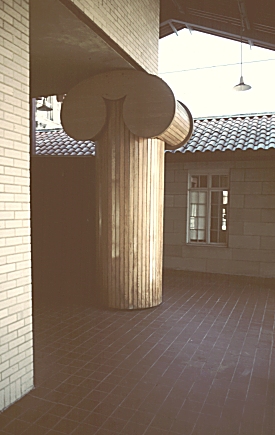 |
| detail of iconic column.<fun in post modernism> |

Allen Memorial Art Museum, Oberlin College
He and his wife form new vision toward architecture, the notion of, looking at architecture as a sign. They don't really want to put label on anything that they do and the goal is that they want people to use the spaces that they created as they wanted to without worrying that it is a kitchen or dining room. However, they didn't succeed to convey this notion in most of their works though. I loved that he stated in his article " complexity and contradiction in architecture that " I am for richness of meaning rather than of meaning; for the implicit as well as explicit function. I prefer "both and" to "either or", black and white and sometimes gray, to black or white. I love how he tried to expressed that his architecture concerned both aesthetic and function. He began to play between with the color in between primary pallete as well as mixing classical and modern architecture together.
There is another group of architects, that form in late post modernism, being called, The new york five including, Peter Eisenman, Richard Mier, Michael Graves, Charles Gwathmey, and John Hejduk. They were being refer as the white because they started to study from Modernism anda common allegiance to a pure form of architecture modernity, harkening back to the work of Le Courbusier, in 1920-1930s. However, on closer examination their work was far more individual.
The New York five was being attacked by early post modernism <especially Robert Venturi> that they didn't care or pay attention to the context, users, or the functioning. And Venturi was right on all the point that he blame about their works.
The best example of the house that was created intentionally to be "a pure object" that stripped away from any definition of the "house". It's "HOUSE VI" by PETER EISENMAN. The goo lo from new york five. I believe that, he would be the one of architect that being hate as well as admire at the same time. He loves to show off that he knows best and he proves that he really knows what he's talking about. He would pick the subject that people overlook and studied thoroughly till he found the way to know best in that matter. That would be one best reason that I admired him that we can learned a lot from his love with being goo lo as well as his changes over time.
Eisenman is well-known of being talk-chitect because he talks and write a lot compare to the works that he had comission to build. He also believe that architecture can be interpretated from texts <linguistic theories>. He wrote one article called " The end of classical: The end of begining, the end of the end" which i had a really hard time to read because his way of using perfectly hard-to-get language. I mentioned this article because, it attacked on modernism as well as Post modernism < Robert Venturi>.
First get on with Modernism where he said "it is timelessness" If Adolf Loos still alive, I think they would have a big fight on this matter. He stated that the attempted that Modern was trying to say that they didn't depend on any subject that exist before wasn't true. The column is still a column, it is still bearing the weight, they just eliminate the decorative elements. They only simplified the existing objects and in that attempt they lost their identities which led them to notion of "Timelessness". Wow! Moreover, the way Modernism trying to set their goal about function is " representation". So they pretty much can't get out of what they were trying so hard to stay away from.
Second shot go to Robert VenturiDoges's palace and Sansovino's library. Ouchhhh...... the notion of the "duck" is quite famous for Venturi.
Ok, now let's focus on Eisenman architecture masterpiece, House VI. Eisenman still treat architecture as a sign and where he wanted people to consider to use or question about the spaces that he provided. For House VI, he went so far where he went step by step translate the form from the process from his diagram then he just put the house afterward which means "FUNCTION FOLLOW FORM/ART". He didn't concern about the owners as much as his architecture so they needed to followed what they were given to live within. However, after all, the owners love the house and they are grateful to Eisenman <after all the complaint and fight>

HOUSE VI LIVING ROOM


view between two intersection "stairs" floating "columns" and seperate beds
In conclusion, we can see that every architecture have its own value as well as contradiction in itself so the thing that make it's famous is that they actually have "The innovative of representing themselves" as well as their identity that stripped away from the past. Or what we "EVOLUTION".
"Play time" playing with modernism and Louis I kahn in this matter.
"Play time" was a directed by Jacques Tati in 1967, the way this movie interpreted "Modernism" is quite interesting as well as funny. At that time, Americans love modernism because of they wanted to show their power in term of technology as well as the notion of mechanism. And this movie actually capture the dream of modernist especially for Miesian where everything is a box and they are clean, clear, and being in repeated order. People would walk or even dressed in the same style. The movie actually captured the way that the lead actor got lost in the building and trying to find one person but lost in the "boxes".
I really love the way he played with how people was so "into machines and all the popular culture untill they lost their identities" they are all the same!!!! This is really movie depict "Modernism ideology" of how they view over people, convey the notion that people are all the same in every way including their senses, perception, basically everything.
In my opinion, this movie/documentary actually tried to delivered depicting the way the city would became if they still believe in one certain way without giving themselves any other options. This is one thing that I don't really like in "Modernism" where they were being so strict and strubborn with what they were after. The evolution is good and i think most of architects/artists love to see innovative things but with all the limitation that they sat <modernists> and treated people as if the object or sculptures were kind of too much. That's why there is another group of poeple that opposed and then we have post-modernism which totally being opposite to modernism. For example, in early post-modernism, they would just put the decorative elements just to convey or say "HEY LOOK! I'M NOT MODERNISM" which was quite extreme but for me they just led people to see another things that art and architecture can offer.
If we say about issue or being controdict with Modernism, we cannot forget this guy "LOUIS I. KAHN" who was in between modern and classical. In the begining of his career, he was one of modernist but then realized that he was not going anywhere with this "compound" so he went around the world and travelled and made a lot of sketchs that i showed you in previous article about him. Even if he sketched classical building where there are many ornamantal, we did not pay attention to the detail but the shadow and the composition. Most of his building was a combination of the two movements where he still being critical about the geometric shape but for materials as well as the concern over context and surrounding was his best well-known and bring him into the frame.
People who closed to him knew that he loved his work was first priority for him where he invested his everything to research, design, and build.
I think, Louis I. Kahn is a fine and clear example of architect who stand by their concept and being compromised to what was existed before and use them wisely. He didn't forget about classical/ Renaissance and still doing designing something that people at that time reconized but in his own way. We could really see that the last master piece that he wasn't even there when it actually finished " national assembly building" in Bangladesh had a great impact to people in that region. We could see in the documentary "my architect" that directed by his only son Nathaniel Kahn that people was admired the architect and how they appreciated that he bulit the icon or the landmark in their homeland that was and still poor.
The thing that Kahn had and Modernism and Post modernism lacked was about how he looked to things and researching till knowing the context, people , the way they lived their lives, and using that as well as the things that we learned from existing architecture combining together to form his works. And i think, If there were Kahns' building in "play time" the movie would have more chaotic or variety of people and how they expressed their identities.
I want to end with a really famous quotes from Kahn that really inspired me,
“I just want to make my last demand in reverence to the work of what has been done by architects of the past. what was, has always been. what is, has always been. and what will be, has always been. such is the nature of beginning.” – louis kahn
It's ashamed though that he had only short amount of time after people accepted his works so let's keep our mind open to innovation there's nothing right or wrong as long as we have logic and reason and don't forget about aesthetic.
Another nice thing that "I.M. PIER" said during interviewing with Kahn's son that "5-6 masterpieces of architecture is better than building 50-60 building, quality not quantities" he became my idol after this. Very witted and humble architect.
 |
| boxes in box. |
 |
| apartment units <wow how homogeneous> |
 |
| Mie's city! |
I really love the way he played with how people was so "into machines and all the popular culture untill they lost their identities" they are all the same!!!! This is really movie depict "Modernism ideology" of how they view over people, convey the notion that people are all the same in every way including their senses, perception, basically everything.
In my opinion, this movie/documentary actually tried to delivered depicting the way the city would became if they still believe in one certain way without giving themselves any other options. This is one thing that I don't really like in "Modernism" where they were being so strict and strubborn with what they were after. The evolution is good and i think most of architects/artists love to see innovative things but with all the limitation that they sat <modernists> and treated people as if the object or sculptures were kind of too much. That's why there is another group of poeple that opposed and then we have post-modernism which totally being opposite to modernism. For example, in early post-modernism, they would just put the decorative elements just to convey or say "HEY LOOK! I'M NOT MODERNISM" which was quite extreme but for me they just led people to see another things that art and architecture can offer.
 |
| Louis I. Kahn |
If we say about issue or being controdict with Modernism, we cannot forget this guy "LOUIS I. KAHN" who was in between modern and classical. In the begining of his career, he was one of modernist but then realized that he was not going anywhere with this "compound" so he went around the world and travelled and made a lot of sketchs that i showed you in previous article about him. Even if he sketched classical building where there are many ornamantal, we did not pay attention to the detail but the shadow and the composition. Most of his building was a combination of the two movements where he still being critical about the geometric shape but for materials as well as the concern over context and surrounding was his best well-known and bring him into the frame.
 |
| salk institute |
 | |
| national assembly building in dhaka, bangladesh |
People who closed to him knew that he loved his work was first priority for him where he invested his everything to research, design, and build.
I think, Louis I. Kahn is a fine and clear example of architect who stand by their concept and being compromised to what was existed before and use them wisely. He didn't forget about classical/ Renaissance and still doing designing something that people at that time reconized but in his own way. We could really see that the last master piece that he wasn't even there when it actually finished " national assembly building" in Bangladesh had a great impact to people in that region. We could see in the documentary "my architect" that directed by his only son Nathaniel Kahn that people was admired the architect and how they appreciated that he bulit the icon or the landmark in their homeland that was and still poor.
The thing that Kahn had and Modernism and Post modernism lacked was about how he looked to things and researching till knowing the context, people , the way they lived their lives, and using that as well as the things that we learned from existing architecture combining together to form his works. And i think, If there were Kahns' building in "play time" the movie would have more chaotic or variety of people and how they expressed their identities.
I want to end with a really famous quotes from Kahn that really inspired me,
“I just want to make my last demand in reverence to the work of what has been done by architects of the past. what was, has always been. what is, has always been. and what will be, has always been. such is the nature of beginning.” – louis kahn
It's ashamed though that he had only short amount of time after people accepted his works so let's keep our mind open to innovation there's nothing right or wrong as long as we have logic and reason and don't forget about aesthetic.
Another nice thing that "I.M. PIER" said during interviewing with Kahn's son that "5-6 masterpieces of architecture is better than building 50-60 building, quality not quantities" he became my idol after this. Very witted and humble architect.
Saturday, March 12, 2011
The new way of interpretation from Louis I kahn.
From what the moment i watched the movie "My architect" which was created by Kahn only son "Nathaniel Kahn" who was quite carried away or developing some feeling over what he had been through with the documentation. I was carried away by the way people reacted about "Kahn's mystery life and his dedication to his architecture". This movie is delivered so many different messages to how we should balanced all the things in our lives. It's really good documentation and we can see that Kahn would give anything up for his career and he is like the artist of his own. he didn't really pertain to choosing the side or put the "label" on his style at that time and it was big. Everybody would say he's nomad and he would spent his time in the office or out to the world, sketching exploring and seeing things and learn from the context. On one part of documentary that Nathaniel interviewed "I.M. Pie" about his opinion over Kahn and he talked about how stubborn Kahn could be with the clients and how he would be able to handle those situation better but then Nathaniel went on about how successful he is<I.M. Pie> kind of compare to Kahn and then he responed " building many buildings doesn't mean success, 4 or 5 masterpieces is better than 50-60 building" "quality not quantities". I was quite caught up with this phrase and i think it defined Kahn best where he didn't build lots of building but most of them expressed himself and his passion through people in and context. Here is the movie cover, a really good one.

So let's get to Kahn's architecture. I have to admitted that now I a really superficial information about this guy's works and i definitely dig more about this guy but after i researched a little about him we would see that he followed what was there which was " international style" and then it wasn't his best so he went to Europe and explore his interest and all the sketches that he produced were interpretated in his language, understanding at that particular places and time. I mean, when he got that sense, he developed his understanding towards what was already existed both which are classical and international style. The first major building that he had commissioned was "Yale art gallery" where he chose the material that quite heavy looking as well as wieght " brick" where modernism hates it, it could be considering as bourgeois. however, the building was there and it responded with its context and the quality of light and how he actually having concern or treating people who use the specific space made this gallery a breakthrogh.
As we see the picture above we could see that how he learned from what he saw and he actually sketched what he really think was important to him because if we go to Italy we would see just the there alone in the deep shadow with not much decoration as well as the houses that plain without "ornamental or decorative elements". However, he saw that potential of lighting and the aesthatic of the classical style so he did the building that was not on either side but using both of them as a lesson or device and of course open the new way to look at architecture and for sure cause so much controversy at that time.
I personally, think that when we tried to change from one phrase to another one, we tended to denied the past or just simply forget to learn from them like modernism and post modernism where they tried to do what so called "Evolution" where they so hard to stayed from what they opposed but for Most of Kahn masterpieces kind of say hey wait a minute if we started to put things together in certain way, we can make it work as well as still pleasing the both companies satisfication which is function and aesthetic. Because for international style they trusted their research that people are all the time there is no individulities and they tried so hard to stay away from what was there before. But could they really did that, of couse not, then we have post modernism where they simply hates the way modernism just kind of being too strict with what they see. they considered architecture as one piece of art where we can see it differently and challenge people perception but let alone what is functional should be like.
However, both of this compound or movements weren't bad, it's innovative thinking but they didn't care so much with many things which make their buildings and movement significant. As a student, we have so much oppotunities to learn from them and see their flaws and think of our working process and how should we do with our project, or what should we deal or focus on at the time.
So let's get to Kahn's architecture. I have to admitted that now I a really superficial information about this guy's works and i definitely dig more about this guy but after i researched a little about him we would see that he followed what was there which was " international style" and then it wasn't his best so he went to Europe and explore his interest and all the sketches that he produced were interpretated in his language, understanding at that particular places and time. I mean, when he got that sense, he developed his understanding towards what was already existed both which are classical and international style. The first major building that he had commissioned was "Yale art gallery" where he chose the material that quite heavy looking as well as wieght " brick" where modernism hates it, it could be considering as bourgeois. however, the building was there and it responded with its context and the quality of light and how he actually having concern or treating people who use the specific space made this gallery a breakthrogh.
 | |||||||||
| the sketch from europe before he built "Yale art gallery" |
 |
| Yale art gallery |
I personally, think that when we tried to change from one phrase to another one, we tended to denied the past or just simply forget to learn from them like modernism and post modernism where they tried to do what so called "Evolution" where they so hard to stayed from what they opposed but for Most of Kahn masterpieces kind of say hey wait a minute if we started to put things together in certain way, we can make it work as well as still pleasing the both companies satisfication which is function and aesthetic. Because for international style they trusted their research that people are all the time there is no individulities and they tried so hard to stay away from what was there before. But could they really did that, of couse not, then we have post modernism where they simply hates the way modernism just kind of being too strict with what they see. they considered architecture as one piece of art where we can see it differently and challenge people perception but let alone what is functional should be like.
However, both of this compound or movements weren't bad, it's innovative thinking but they didn't care so much with many things which make their buildings and movement significant. As a student, we have so much oppotunities to learn from them and see their flaws and think of our working process and how should we do with our project, or what should we deal or focus on at the time.
Sunday, February 20, 2011
God of materials and details in architecture world, Mies van der Rohe.
FRANK LLOYD WRIGHT 1931 american architecture where he metioned "WHEN YOU GET BELOW THE SURFACE, NO MATTER HOW PLAIN MODERNISTIC IS, IT IS STILL MERELY ORNAMENTAL"
One would say that Mies's building looks like the simplest things you could imagine where there is glass box and some steel showing its structural parts. Modern was supposed to remarked the world, and Mies was at the center of revolution, however, he was also a counterrevolutionary who designed beautiful things. He is probably the only modernist who created a language that still have some scent of the past where he was coming from. After the Bauhaus was forced to close, after one year of not doing any much, Mies decided to go to America while he couldn't speak any english. Yet within a few years of his arrival in Chicago, where they had a major tragedy, fire and people strive for the new design of architecture as well as when America won World war II and want the world to know that they were powerful and won by the newest technologies so Mies had become the most powerful aesthetic force in American architecture after Frank Lloyd Wright. He wasn't a kind of person who rhapsodizing about glories of architecture, his only interest was in physical form, and he was fanatical in his search for ways to perfect it. Most of Mies's building were a lot more complicated than they appeared, and he was willing as many other architect to indulge in ornament when it suited his purposes. I personally see this kind of move about flexibilities of how he viewed or wanted people to perceived architecture is quite a good approach to what we should learn from him. That's architecture is flexible and can stray from what you've believe before. One of good example is a Seagram Building, if you look carefully , you see that the exterior isn't flat, but is lined with little I-beams between the windows. They aren't part of the structure which was against the believed of Modernism where everything has to function. They were put there to provided texture and to make the building softer. On the sides of the Seagram, where the structural engineers had demanded solid concrete wall to stabilize the narrow tower against heavy wind loads, Mies was covering the concrete by marble and then put the I- beam on top so that it would look like the framing around the windows like elsewhere in the building.


He was also the architect who concerned about the details and materials. I think, he was paying this much attention because his family business as well as the place that he came from was plenty of Gothic architecture. It was the first architecture that allowed that much transparency into the building. Gothic was the first style in classical that overcome stone and i think, we can't count Mies as a religious architect but those works might influences him in some way about transparency.
Back to America, before Mies was transforming the cities, the architecture there was quite solid, masonry cladding was the main ideal building at that time. He transform the cities into the glass boxes skyscrapers that he was trying to use glass as a reflective elements to reflect all of the context like a painting.
Another, controversial work of his is the famous "Farnsworth house" where there showing the flowing into each spaces and it was sitting on the land that actually have 3 levels but Mies decided to put the house into the lowest level beside the river where there is a flood every year. He overlooked that matter because he only concerned with continuous line of the house and landscape i suppose. This house also showed his obsession over details where he uses a few honest materials and painted white to make the building look pure and floating. He also concerned about the notch that had to be in the finest condition and so the workers had to sand till those notch actually almost invisible before painted.


One would say that Mies's building looks like the simplest things you could imagine where there is glass box and some steel showing its structural parts. Modern was supposed to remarked the world, and Mies was at the center of revolution, however, he was also a counterrevolutionary who designed beautiful things. He is probably the only modernist who created a language that still have some scent of the past where he was coming from. After the Bauhaus was forced to close, after one year of not doing any much, Mies decided to go to America while he couldn't speak any english. Yet within a few years of his arrival in Chicago, where they had a major tragedy, fire and people strive for the new design of architecture as well as when America won World war II and want the world to know that they were powerful and won by the newest technologies so Mies had become the most powerful aesthetic force in American architecture after Frank Lloyd Wright. He wasn't a kind of person who rhapsodizing about glories of architecture, his only interest was in physical form, and he was fanatical in his search for ways to perfect it. Most of Mies's building were a lot more complicated than they appeared, and he was willing as many other architect to indulge in ornament when it suited his purposes. I personally see this kind of move about flexibilities of how he viewed or wanted people to perceived architecture is quite a good approach to what we should learn from him. That's architecture is flexible and can stray from what you've believe before. One of good example is a Seagram Building, if you look carefully , you see that the exterior isn't flat, but is lined with little I-beams between the windows. They aren't part of the structure which was against the believed of Modernism where everything has to function. They were put there to provided texture and to make the building softer. On the sides of the Seagram, where the structural engineers had demanded solid concrete wall to stabilize the narrow tower against heavy wind loads, Mies was covering the concrete by marble and then put the I- beam on top so that it would look like the framing around the windows like elsewhere in the building.

Back to America, before Mies was transforming the cities, the architecture there was quite solid, masonry cladding was the main ideal building at that time. He transform the cities into the glass boxes skyscrapers that he was trying to use glass as a reflective elements to reflect all of the context like a painting.
Another, controversial work of his is the famous "Farnsworth house" where there showing the flowing into each spaces and it was sitting on the land that actually have 3 levels but Mies decided to put the house into the lowest level beside the river where there is a flood every year. He overlooked that matter because he only concerned with continuous line of the house and landscape i suppose. This house also showed his obsession over details where he uses a few honest materials and painted white to make the building look pure and floating. He also concerned about the notch that had to be in the finest condition and so the workers had to sand till those notch actually almost invisible before painted.
 |
| Fransworth house in flooding condition. |

This house was also being compare as a manipulation from Temple of Greek or the modern building that interpretive from Greek architecture. I would leave that for you to decide.
The Crown hall is another piece of architecture that Mies created upon his obsession of materials. It was building by steel and glass. The building sit in the cold area where steel wasn't a really good choice of material.
crown hall
Mies used to teach here where he didn't speak much but what he concerned and teach the students the most is how to use the materials and how to build or cut them. As well as how to assemble the different pieces of materials. Below is some fine example of how he concentrated on detail of materials.

There are some works of Mies that is bad and good. Some of his work seem so simple, too simple, where they raised the raise another quote that went against Mies which is " Less is bore" by Venturi. However, if we overlooked that and see what he teach us as an architecture student, we would appreciate that he actually exist where he teach us about how to appreciate the materials, the textile of them. how we should care about the details of each building that we will build in future, hopefully. As well as, the way to do our own design by not just following the label that he had before as a Modernist where everything had to function.
analysis of house vi Peter Eisenman.
we have been doing project about learning from master and how learn how they projected or expressed their interpretation of architecture at that time and seeing how disadvantage as well advantage of the design that they did. I am glad that i'm actually having opportunity to do House VI by Peter Eisenman because this man is so critical about everything around him and it makes me curious about whole bunch of things that i never paid attention to. I was being ask if i wanted to do something like this particular design of his and as i came back and think hard of it. I definitely would if the client was willing me to do this kind of new experimentation where we only concern about our design as well as the process of conceptually thinking. However, in real lives we would not have opportunities like this much for the house because it was there to serve the users. It's not installation or museum where we can play with all the spaces as well as the concept of perception and contradiction. In my view, this house actually raised the concerned as well as controversy about the possible way to live. I wasn't wrong or right but actually the successful of experimentation where he only concern about his own design and that my view about this house. Here is some analysis of the house that i actually did for analysis phrase.
Sunday, February 6, 2011
Le corbusier theories vs Peter Eisenman theories
First of all, i would want to say that I wasn't really into Le Corbusier method or way of thinking toward architecture at all. It might be because i was only absorbed only one side information from the movement called " Post modernism" where they tend to not only concern about functionalities. However, as I learned and read about Corbusier's theories in details, those suggestion of changing were not all unreasonably. We could not denied that the movement that these guy <Corbusier, Gropuis, and Mies> began changed perspective of how people viewed architecture. Because Modern architecture was began when the world was changing which was after World war 1.The interesting about modern architecture was that it promised the social revolution. it was revolutionary architecture that said our cities were not good to live in. The building was looking toward the past rather than the future as well as that the client was no longer a pope or a duke or whom that was powerful. Architecture was for public. So at that time, these movement gained lots of attention from artists as well as architects from all over Europe. The principle was about purity of every elements in the building, the mechanical paradise, where they wanted to show how the building stand up. Where the building was built to fit the propotion of human. Corbusier was kind of opposed Gothic style in architecture because he said that they were not anything that can defined the "structure" the geometric form that make "Parthenon" so great example above all.
 The above picture is the "Tour de Beurre- Rouen Cathedral" where above all structural as well as the all the excessive decorative elements was totally juxtapost with modernism theory where the function of cornice on longer existed, but they have found the sharp pure line that a flat-roofed building cuts across the brilliant sky.
However, as i mentioned about gothic architecture, it was actually had some critical roles in one of modernist icon, Mies Van de Rohe, whose was changing the architectural history in America. His work was about steel that reinforced with all the glasses and using the light materials that never before had seen at that in America. At that time after world war 2 most of Americans' building were thick and compose of chunky mansonary. I believe that Mies had learned about how gothic architecture use the glasses tell the story that they wanted to tell people. Mies used the same method but he did not use any color mosaic to do so but he was adapting the ideas of narrative and apply to modern architecture where they believe in " Expressionist structure" So he used the transparency of glasses to make people outside sees through his building as well as the composition of the structural itselves.
In my opinion, i don't think anyone can stay away from the history. I mean that how we develop through every single things, like all the tools and machines that Le Corbusier was obsessed with. One of a really good example that Eisenman stated about this was that modernism was trying so hard to stayed away from the past but however they still use the same idea of columns where they only just eliminate all the size and decorative elements to fit their ideology.
Modernism was all about form follows function. Where everything has to have structural meaning as well as fit the criteria of mass produced where machine and his hypothesis on how or what people should live in certain or limited space.
Even if this this form follows function was intriguing and innovative ideas in the 19 to 20 th centuries. I don't think that functionality are everything in architecture because it is one of the art that act as a place where people can live their lives happily by what they have chosen by themselves. Eisenman reasons about this issue was that such factors as ornament and historical style carry such a powerful associations that they often, in themselves, control how we percieved a building. Function, too, is a kind of controling symbol and since it meets our expectations we are rearly provoked to analyze it more closely. I believe this is the matter of fact that people and architect were thinking or paying all of their attention to how can they make the place all functional and they forgot about "Asthetic" , the elements that really important in art.
Most of Eisenmans' work was dealing with the "pure structure" so pure that stripped away not only from ornament but any sense of style, and even adherence to function. Most of people/architects opposed his ideas and preferred to called him as theorist or talkchitect rather than architect who build things. It's quite true that most of his work wasn't/ haven't built yet. However, when he was open his mouth to critic on something or others work, he would make sure that he was at least knew about it well enough to convinced people to believed that his sides of stories had some potential to be true. People would also argued about his built work that wasn't functioning well due to his consistancy of his own theories.
As i mentioned earier, for example, now i'm doing project " House VI" the house that was recieved many controversy about its asthetic as well as its function. Eisenman named this house "House Vi" because i wasn't for the owner or anyone else, it was all about the experiment that due with space and the notion of inside and outside. This house was being compared with de stijl house "Schroder house" by Rietveld. However, there were many elements that two of these house can't really compare to each other. This house was also kind of challenge the theory of modernism about "form follow function" because this house is about fuction follows form/art. How he began the process with the diagram where Le corbusier mentioned that diagram was important but it's only a tools. Where he concerned about the first 4 planes and after the process of minipulation he just add the volume to the house later on.
The process was really, let's say new and diverse with what we have been thought to think in architectural way. there is some example of the house as well as some eisenmans' work that challenge the universal rule that "Le corbusier respected"


However, as i mentioned about gothic architecture, it was actually had some critical roles in one of modernist icon, Mies Van de Rohe, whose was changing the architectural history in America. His work was about steel that reinforced with all the glasses and using the light materials that never before had seen at that in America. At that time after world war 2 most of Americans' building were thick and compose of chunky mansonary. I believe that Mies had learned about how gothic architecture use the glasses tell the story that they wanted to tell people. Mies used the same method but he did not use any color mosaic to do so but he was adapting the ideas of narrative and apply to modern architecture where they believe in " Expressionist structure" So he used the transparency of glasses to make people outside sees through his building as well as the composition of the structural itselves.
In my opinion, i don't think anyone can stay away from the history. I mean that how we develop through every single things, like all the tools and machines that Le Corbusier was obsessed with. One of a really good example that Eisenman stated about this was that modernism was trying so hard to stayed away from the past but however they still use the same idea of columns where they only just eliminate all the size and decorative elements to fit their ideology.
Modernism was all about form follows function. Where everything has to have structural meaning as well as fit the criteria of mass produced where machine and his hypothesis on how or what people should live in certain or limited space.
Even if this this form follows function was intriguing and innovative ideas in the 19 to 20 th centuries. I don't think that functionality are everything in architecture because it is one of the art that act as a place where people can live their lives happily by what they have chosen by themselves. Eisenman reasons about this issue was that such factors as ornament and historical style carry such a powerful associations that they often, in themselves, control how we percieved a building. Function, too, is a kind of controling symbol and since it meets our expectations we are rearly provoked to analyze it more closely. I believe this is the matter of fact that people and architect were thinking or paying all of their attention to how can they make the place all functional and they forgot about "Asthetic" , the elements that really important in art.
Most of Eisenmans' work was dealing with the "pure structure" so pure that stripped away not only from ornament but any sense of style, and even adherence to function. Most of people/architects opposed his ideas and preferred to called him as theorist or talkchitect rather than architect who build things. It's quite true that most of his work wasn't/ haven't built yet. However, when he was open his mouth to critic on something or others work, he would make sure that he was at least knew about it well enough to convinced people to believed that his sides of stories had some potential to be true. People would also argued about his built work that wasn't functioning well due to his consistancy of his own theories.
As i mentioned earier, for example, now i'm doing project " House VI" the house that was recieved many controversy about its asthetic as well as its function. Eisenman named this house "House Vi" because i wasn't for the owner or anyone else, it was all about the experiment that due with space and the notion of inside and outside. This house was being compared with de stijl house "Schroder house" by Rietveld. However, there were many elements that two of these house can't really compare to each other. This house was also kind of challenge the theory of modernism about "form follow function" because this house is about fuction follows form/art. How he began the process with the diagram where Le corbusier mentioned that diagram was important but it's only a tools. Where he concerned about the first 4 planes and after the process of minipulation he just add the volume to the house later on.
The process was really, let's say new and diverse with what we have been thought to think in architectural way. there is some example of the house as well as some eisenmans' work that challenge the universal rule that "Le corbusier respected"


Tuesday, February 1, 2011
Paul Rudolph
This guy drawing are really amazing so i want to show some of his drawing that would make you go wow!!!! I actually did not know much about this guy, right now. But i will definately definately learn about him determinately. and thanks to one of my friend that told how great he was especially his drawings. so discovered more and learn even more. here are the drawing.


Sunday, January 30, 2011
from metropolis to Bauhaus
ok! let's start with the general infomation with of the film. It's called metropolis was produced Fritz Lang in 1927. The film interpretated urbanity in a " HARSH WAY" They use the level of the group defined class of people where the all the working class is in " the depth" down below the earth the cave like factory where the heart of energy was operated. They show how the workers and everyone in the city was actually annymous except for " JOH FREDERSON '' who rule the city. even the son of him was refer as Freder which was frederson's son. All the workers were known by the number. They were nothing. They went down below and showing how hard workers all work to keep up with the machine.
 and then cut to the scene where there is joyful party where there is a running contest on the upper city. If we notice we can see that the size of human and the wall of the stadium was totally different. This thing might apply to the "classical time" where they built the building for god for timelessness so the building would be high to serve that purpose. Then they cut to the scene where freder was in his "eternal garden" that his father was created for him where there was a sculpted columns and the fountain where "BAUHAUS" theory was totally trying to demolish. However, the movie start to fate to more drama when the woman name "Maria" where she bring all the children from down below and tell freder that they are his brother who deserve better. And that when Freder decided to go down and find out what was going on down below the earth where he found that people work like the machine < so robotically> and how the machine can really harm them when there was a mistake. He was hallucinate that the machine was some kind of demon and then when the crisis end, workers from other shift took over as if nothing happens and the people who got injure or death was removed to somewhere else. and then the production line began again.


They were showing how terrified Freder was so he ran to elevator to his father's office upper city. The way they decorated "Fredersen's office" was quite interesting where there was one huge table in the middle of the office and no decorative elements just pure machine. and the huge grid window to look out in front of his desk where he can see outside as well looking in. < sound fimiliar use of glass corner and expression structure> however, there were the scene were they show the whole picture of the upper city and then i realize that most of the are really in Bahaus and Le corbusire theory except the middle where there was still showing some curvy line of structure on the roof that wasn't doing any work. ok then let's get back to the topic that Freder told his father that how terrible of the depth was and what would he do if they raise against him. Fredersen was quiet for awhile and looked at his worker about why he learned this from his son not him so he just cruelly fired that guy. The guy was trying to kill himself because he didn't want to be in " the depth".
However, Freder was after him and offer the worker a job to be him while he will be down below experience and find the solution of the problem, they agreed and did that. and then the story go on and and on about how they imitated the machine that look like Maria the mediator in order to ruin the plan of revolution and then Fredersen got betrayed by the scientist. however, his son was the one who help him and the workers compromise at last. At this scene we can see that the place that they try to compromise was all well-decorated, there were many sculptures on the and as well as the oversize door behind them.
The movie was capturing how people were so afarid with the word " the machine" and how workers seem to be like nothing but tools at that time. I personally, think actually showing both negative side of even if they tried to stay away from the past and trying to do a better future. The workers still have to work hard, still have to do mass-production. Where Bauhaus architects thought that it was good that use honest materials and workers would help them to have a better lives. maybe they were wrong because the one who commission all those project for the workers still the high class people and they wouldn' t have to care anymore about their workers because the machine can do anything. This movie is actually capturing another perspective toward the mass-produced. Bauhaus architects tried to built the house for the workers where they limited everything and people couldn't complain about it and have to follow so what's the point at the first place to tell people that they would not have to suffer under anyone order anymore, they would be free! Yeah! < but you have to do what we told you to do so as well as working as hard because mass produce were good, it saved money.> but i'm not sure, it actually really have any benefit to the workers at all.


They were showing how terrified Freder was so he ran to elevator to his father's office upper city. The way they decorated "Fredersen's office" was quite interesting where there was one huge table in the middle of the office and no decorative elements just pure machine. and the huge grid window to look out in front of his desk where he can see outside as well looking in. < sound fimiliar use of glass corner and expression structure> however, there were the scene were they show the whole picture of the upper city and then i realize that most of the are really in Bahaus and Le corbusire theory except the middle where there was still showing some curvy line of structure on the roof that wasn't doing any work. ok then let's get back to the topic that Freder told his father that how terrible of the depth was and what would he do if they raise against him. Fredersen was quiet for awhile and looked at his worker about why he learned this from his son not him so he just cruelly fired that guy. The guy was trying to kill himself because he didn't want to be in " the depth".
However, Freder was after him and offer the worker a job to be him while he will be down below experience and find the solution of the problem, they agreed and did that. and then the story go on and and on about how they imitated the machine that look like Maria the mediator in order to ruin the plan of revolution and then Fredersen got betrayed by the scientist. however, his son was the one who help him and the workers compromise at last. At this scene we can see that the place that they try to compromise was all well-decorated, there were many sculptures on the and as well as the oversize door behind them.
The movie was capturing how people were so afarid with the word " the machine" and how workers seem to be like nothing but tools at that time. I personally, think actually showing both negative side of even if they tried to stay away from the past and trying to do a better future. The workers still have to work hard, still have to do mass-production. Where Bauhaus architects thought that it was good that use honest materials and workers would help them to have a better lives. maybe they were wrong because the one who commission all those project for the workers still the high class people and they wouldn' t have to care anymore about their workers because the machine can do anything. This movie is actually capturing another perspective toward the mass-produced. Bauhaus architects tried to built the house for the workers where they limited everything and people couldn't complain about it and have to follow so what's the point at the first place to tell people that they would not have to suffer under anyone order anymore, they would be free! Yeah! < but you have to do what we told you to do so as well as working as hard because mass produce were good, it saved money.> but i'm not sure, it actually really have any benefit to the workers at all.
Subscribe to:
Posts (Atom)